I Organized My Files and Accidentally Started Thinking 我整理了一下文件夹,然后不小心开始思考人生
I set out to organize my files and ended up confronting the oldest question in philosophy. On structure, agency, and why knowing yourself matters more than ever in the age of AI. 我本来只是想整理文件夹,结果撞上了哲学里最古老的问题。关于结构、自主性,以及为什么在AI时代,认识自己比以往任何时候都更重要。
- Organizing files turned into organizing my thinking
- Structure is the bandwidth of the human-AI interface
- Humans and machines are mutually constructing each other
- A Personal OS is not a productivity system — it's a self-knowledge practice
- 整理文件夹变成了整理思维
- 结构,就是人机接口的带宽
- 人和机器,在互相塑造
- 个人操作系统不是效率工具,而是认识自己的实践
This is the second in a two-part series about building a Personal OS. The first article covers the architecture and implementation. This one covers the why.
By late 2025, AI had crossed some invisible threshold, and after that, everything started moving at the speed of a caffeine-fueled fever dream. One week it was AI agents that would “do everything for you.” The next week, everyone was installing “skills” like they were collecting Pokémon cards. A few days later, some new open-source model arrived and the entire internet rearranged its personality around it. Social media was wall-to-wall proclamations of doom and revolution. Layoffs in news feed, sandwiched between ads for AI courses that promised to make learners “future-proof.” Somewhere, someone published a PDF called “THE 2028 GLOBAL INTELLIGENCE CRISIS” and it spread like a grease fire through social media.
I wanted to keep up. I really did. But every time I sat down to learn the latest thing, three newer things had already replaced it. I hadn’t even figured out how to write a decent prompt before the next paradigm shift told me prompts were already obsolete. The tools kept shapeshifting. The discourse kept accelerating. My brain felt like a browser with forty tabs open and every single one of them playing a different podcast at 2x speed.
So, in the middle of all this chaos, I made a decisive move. A bold, strategic play for the future: I organized my files.
Organizing Files Is Not Organizing Files
I should confess something: before this, my files were a disaster. My desktop looked like a digital yard sale. System files lived in the Documents folder. Project folders named “final_v2_REAL_final” sat next to screenshots from 2023. I was, in every sense, a child of the modern age. Why organize when you can search? Need something? Type three keywords and there it is. With AI, you don’t even need keywords. Just describe what you’re looking for in plain English and it finds the thing in seconds. Modern tools had made retrieval so effortless that structure felt like overhead. Like ironing your pajamas. Technically virtuous, practically pointless.
But here’s what I discovered when I finally sat down with my mess: organizing files is really organizing your own thinking. Fuzzy ideas about “what matters to me” have to become actual folders with actual names. Vague notions of “my work” and “my life” have to get untangled into real categories with real boundaries. The file system doesn’t accept hand-waving. It demands decisions.
And those decisions are not administrative. They’re cognitive.
Every time you decide where something belongs, you’re making a tiny thinking move. What is this? What does it relate to? Why does it matter? Each one is small. Over years, the compound effect is enormous. The person who makes these decisions builds a living map of their knowledge. The person who doesn’t has a search bar and a vague feeling of “I have something about that somewhere.”
One compounds. The other doesn’t.
Current education treats this like tidiness: clean up your room, sort your folders, label your notebooks. But the real skill isn’t alphabetizing. It’s classification. Relating. Structuring. Seeing what belongs together and what belongs apart. These are cognitive operations that apply to writing, to problem-solving, to communication, to project planning. And now, critically, to how well you work with AI.
So the irony of the AI age is this: as retrieval gets trivially easy, the appearance of structure becomes unnecessary. You don’t need folders when you have search. But the thinking that structure provides becomes more valuable than ever. Because search answers: Where is the thing I want? Structure answers: What do I have, and how does it relate?
The first is a retrieval problem. AI solves it brilliantly. The second is a thinking problem. And thinking problems don’t go away just because the tools got smarter. They go deeper.
Why Structure Matters Now More Than Ever
If organizing files is actually organizing thinking, then the next question is: why does that matter right now? Two reasons: one about the machines, one about us.
The Machine Side: Structure Is Bandwidth
Here’s where it gets concrete. People who can give AI structured context about their thinking, goals, projects and knowledge get exponentially more value from every interaction. Those who can’t are stuck at the “hey AI, find my file” level.
Structure is the bandwidth of the human-AI interface.
Low structure = low bandwidth = AI as a search engine.
High structure = high bandwidth = AI as a thinking partner.
When I sit down with AI and it already knows my mission, my active projects across six life domains, my thinking frameworks and the patterns connecting my learning to my writing to my working, the conversation starts at a completely different altitude. I’m not explaining context. I’m extending thought.
And this gap will only widen. AI’s evolution is heading in two clear directions: connecting to the outside world through protocols like MCP, and connecting to your personal digital space through local system access. Both paths lead to the same place: AI that knows your stuff and can act on it. The trajectory points toward personal agents that anticipate, initiate and synthesize on their own. Personalized models fine-tuned on your data and preferences. This isn’t speculative. It’s the visible roadmap.
When that future arrives, people who have a clearly structured representation of themselves (their knowledge, their goals, their thinking patterns, their values) will be able to plug right in. People who have a scattered pile of files and a search bar will be starting from zero. Structure isn’t just useful today. It’s infrastructure for a future that’s arriving faster than most people expect.
The Human Side: Agency Is Architecture
But here’s the part that matters more. No matter how capable AI becomes, its ultimate purpose is still to serve human needs. And human needs come in two kinds. There are the general ones (communication, productivity, information) that platforms and apps can define for millions of people at once. Then there are the specific ones. Your specific ones. What you’re trying to build with your career. What kind of person you want to be. Which skills matter to your particular path. What trade-offs you’re willing to make right now, and which ones you’re not.
No platform can define those for you. No AI can figure them out on your behalf. And yet, here’s the problem: most of us haven’t defined them clearly for ourselves either.
So what happens when a person who doesn’t know what they specifically need meets a machine that’s endlessly capable of doing things? They delegate. AI agent platforms are going viral. People are downloading skills, automating workflows, handing off task after task. The results are impressive: things get done faster, problems get solved more efficiently. But there’s a quiet cost. When you delegate a task, you gain time but lose the cognitive work that task involved. Some of that work is mechanical, and good to offload. But some of it was building your understanding, forcing your decisions, creating the micro-learning that accumulates into expertise. AI can search, summarize and synthesize in seconds. But it cannot learn for you. It can bring you the materials. It cannot build the house in your mind.
And without a clear sense of what you need, the delegation doesn’t just save you time. It starts steering you. Which ideas AI surfaces, which patterns it reinforces, which directions it nudges. All of it quietly reshapes how you think. Not because AI has an agenda, but because tools shape their users whether anyone intends it or not. The person who automates everything without knowing what they want doesn’t become more productive. They become more dependent, moved by invisible strings they never chose.
This is why building structure yourself matters. Not for efficiency. For clarity.
When I sat down to write my identity file (who am I, what do I value, how do I think, where are my blind spots), I was doing something AI cannot do for me. I was defining my own needs. Not in the abstract journal-prompt way. In the structural way: what are the actual categories of my life? How do they connect? Where is energy flowing and where is it stuck?
Every architectural decision forced a thinking decision. Should “parenting” be separate from “family”? That’s not a folder question. It’s an identity question. Should “learning” sit inside “work” or stand alone? That depends on whether I see learning as instrumental or intrinsic. The answers revealed things about my values that I’d never fully articulated until the structure demanded it.
The person who does this work knows where they are and where they want to go. Like someone who writes a clear brief for their own role, not a job description imposed from above, but one they author themselves. It becomes an expectation they set. And then, every interaction with AI becomes a calibration: Am I moving closer to what I actually want, or drifting further from it?
That’s agency. Not the freedom to do anything, but the clarity to know which things are worth doing.
How I Built It
So I did what felt right in the middle of all the chaos: I organized my files into what I call a Personal OS. It’s a small set of structured markdown files, roughly 20 to 40, that represent my self-model. Who I am, where I’m going, how I think, what I’m working on and how it all connects. AI reads this first in every session. The result isn’t just convenience. It’s a fundamentally different kind of collaboration.
What Makes This Different
The concept of a “personal OS” isn’t new. People have talked about digital twins, personal knowledge management, second brains, personal language models. There’s a growing community of hands-on practitioners building sophisticated systems (tools like Tiago Forte’s Building a Second Brain, August Bradley’s PPV in Notion, or the Obsidian-based Zettelkasten revivalists) and much of that work is genuinely impressive.
But most of these projects share an implicit assumption: the human configures the system, the system serves the human. The arrow goes one way.
My starting point is: humans and machines are mutually constructing each other.
Every time you interact with AI, two things happen at once. You shape the AI’s behavior through your prompts, your feedback, your configuration choices. And the AI shapes you, through which ideas it surfaces, which patterns it reinforces, which directions it nudges your thinking. The question isn’t whether mutual construction is happening. It’s whether you’re aware of it and doing it intentionally.
Think about what happens when a person with no clear self-model starts using AI heavily. They ask AI to organize their priorities. AI suggests a structure. They accept it. They ask AI for a career plan. AI generates one. Sounds reasonable, so they follow it. Over time, AI is making more and more of the framing decisions (what to focus on, what to deprioritize, how to categorize their own life) and the person’s big-picture thinking quietly atrophies. They’re still in the driver’s seat technically, but the GPS is choosing all the routes. That’s what I mean by invisible strings.
Now think about the opposite. A person who has already done the work of defining who they are, what they want and what their current reality looks like. When they hand AI their self-model, the relationship flips. It’s like the difference between a new hire with no job description and one who wrote their own role brief. The first drifts toward whatever tasks land on their desk. The second has an expectation, a clear picture of where they are versus where they want to be, and every interaction becomes a calibration. Is this moving me closer, or further away?
That awareness changes everything, including the design of the system itself. The system I ended up with has three layers: a “brain” layer (small, structured, the meta knowledge about “me”), a “body” layer (where actual life and work data lives, selectively shared with AI), and a private vault (encrypted, AI-excluded). That three-layer split maps to something permanent about being human: the public self, the working self and the protected self. The exercise of drawing those boundaries (deciding what AI should see, what it can access on request, and what it should never touch) is itself a practice in self-knowledge.
Where the Compound Interest Lives
The most valuable form of intelligence isn’t depth in a single domain. It’s the ability to see that a pattern in one domain applies to another. The systems thinking you apply at work can reshape how you approach writing. The writing insight you had last Tuesday connects to the product architecture you’re stuck on. The architecture you developed for yourself turns out to be exactly what your learning framework needs.
This kind of transfer is almost impossible in a flat, unsorted information landscape. You only discover connections between things when those things have some kind of spatial or categorical relationship, when they live in a structure that lets you see across domains rather than just within them.
My Personal OS was explicitly designed for this. The “connections” layer (a living map of active work across domains, plus AI-maintained cross-links and a transfer log) exists to make visible what would otherwise stay hidden. With some settings, AI can help me check periodically: does anything from this conversation connect to another active domain? A messy desktop is a collection of isolated dots. A structured system is a network. And networks generate emergent properties that their individual nodes never could.
Starting Point, Not Destination
My Personal OS is not finished. It won’t ever be finished. It’s a living system. The identity file will be rewritten as I change. Goals will shift. New frameworks will emerge. Old domains will archive and new ones will appear. And because the whole thing is version-controlled with git, every evolution is recorded. The changelog becomes a human-readable version history of me, accumulating entries over years into a compressed narrative of personal evolution. The diffs between versions will show how my thinking changed, not just what I thought.
The system evolves on three fronts at once. The self-knowledge deepens:
- I get better at articulating who I am and what I’m building.
- The tools mature: AI becomes more capable of proactive synthesis, working across my domains without being asked.
- And the practice itself sharpens: I learn when to give AI what level of context, what to share and what to keep private, how to be more intentional about what goes in and what stays out.
The value isn’t in having a perfect system. The value is in the ongoing practice of structuring, examining and articulating who you are and what you’re building. That practice keeps you in the driver’s seat during a stretch of history when it’s very easy to become a passenger.
The Only Question That Hasn’t Changed
The world is changing faster than any of us can track. New AI models drop monthly. Yesterday’s workflow is today’s legacy. The tool you just learned is already being replaced by a tool that learns for you. If you feel a low hum of unease underneath all the productivity gains, you’re not imagining it. Here’s what I think that feeling is really about: we’re losing the sense that we know what we’re doing and why. The tools keep changing, but the deeper question hasn’t changed in thousands of years. Who am I, and what am I trying to build with my time?
He who has a why to live can bear almost any how.
— Nietzsche
The “how” changes every month now. The “why” is what keeps you from drowning in it.
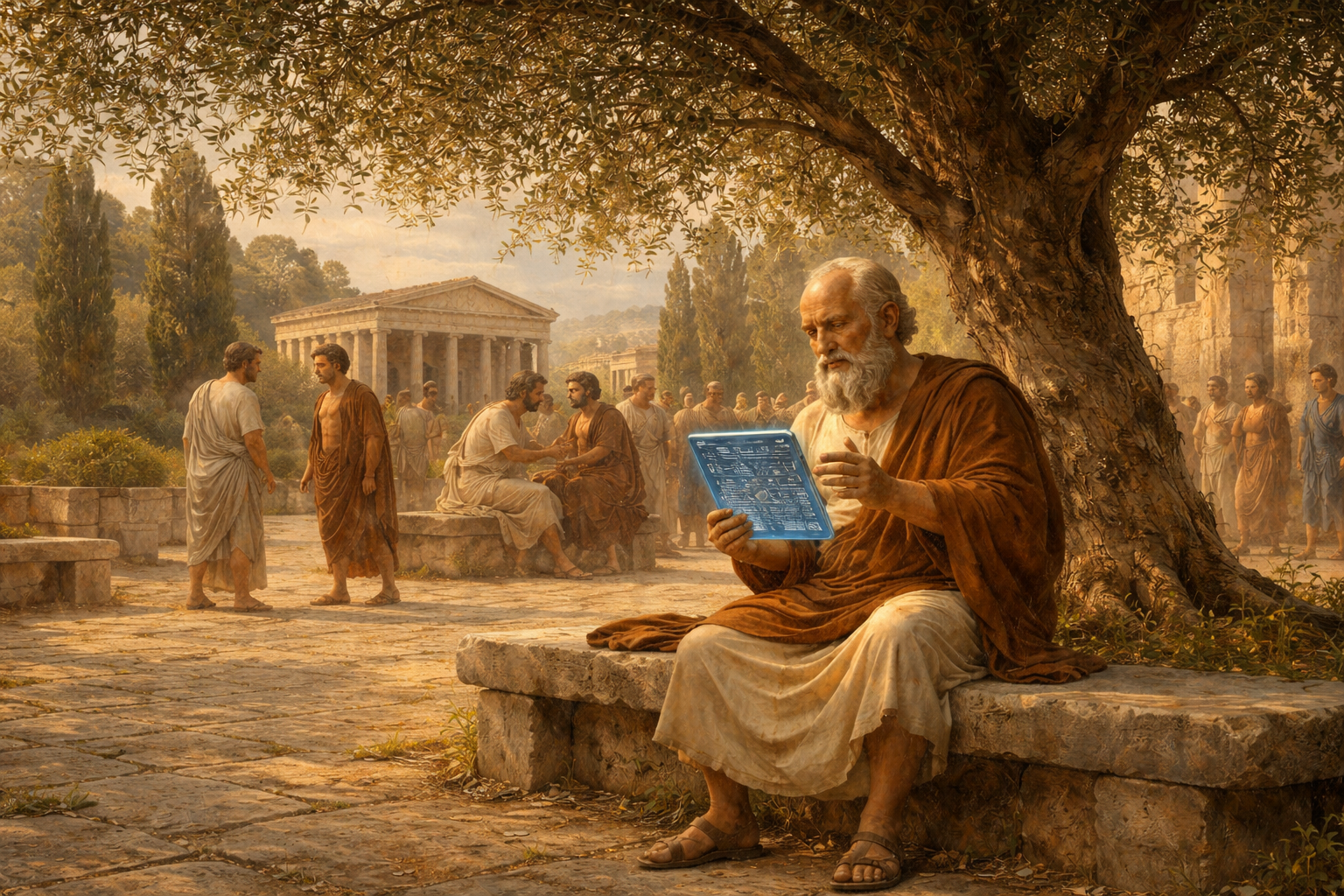
And maybe that’s the real discovery hiding inside this whole exercise. I set out to organize my files. I ended up confronting the same question that Socrates badgered people about in the Athenian marketplace, that Montaigne circled in his tower, that every contemplative tradition eventually arrives at: know yourself. The tools for asking that question have changed beyond recognition. The question itself hasn’t moved an inch.
A Personal OS won’t answer it for you. But it will force you to keep asking. And in an age where everything else is being automated, the willingness to sit with a hard question rather than delegate it might be the most human thing left.
这是「个人操作系统」系列的第二篇。第一篇讲架构和实现,这一篇讲:为什么。
2025年底,AI的能力悄悄翻过了某道分水岭,然后一切就像被谁按了快进键。这周是各种AI智能体满天飞,号称要替你把活全干了。下一周满屏都是”技能包”,人人都在攒,就跟集Pokemon卡似的。再下一周,某个新的开源模型横空出世,整个互联网又集体换了一张脸。社交媒体上天天都在”见证历史”。打开新闻全是裁员,中间穿插着各种”AI时代生存指南”的课程广告。更别提那些标题写着”2028全球智力危机”的报告,在朋友圈传播的速度比八卦还快。
我想跟上,真的想。但每次坐下来准备学最新的东西,三个更更新的东西已经把它拍在了沙滩上。Prompt还没搞明白怎么写,人家告诉我prompt已经过时了。工具在变形,话语在加速,我的脑子像同时打开了四十个标签页的浏览器,每一个都在用两倍速播放不同的播客。
于是,在这一片兵荒马乱之中,我做出了一个果断的决定。一个面向未来的、深思熟虑的战略举措:我整理了一下文件夹。
整理文件夹不是整理文件夹
先坦白一件事:在这之前,我的文件管理基本属于”放弃治疗”的状态。桌面像跳蚤市场,系统文件住在”文档”文件夹里跟工作文件当室友,命名为”最终版_v2_真的最终版”的项目文件夹旁边躺着2023年的截图。我是一个充分顺应时代洪流的现代人:干嘛要整理?搜索一下不就好了?需要什么东西,输三个关键词就找到了。有了AI,连关键词都不用想,随便用大白话描述一下,几秒钟就给你翻出来。现代工具把”找东西”变得毫不费力,于是”整理”显得多余了。就像熨睡衣,道理上没错,实际上没必要。
但当我终于坐下来面对这堆乱摊子的时候,我发现了一件事:整理文件夹,说到底,是在整理自己的思维。脑子里模糊的”什么对我重要”必须变成一个个有名字的文件夹。含混的”我的工作”和”我的生活”必须拆解成真实的类别,划出真实的边界。文件系统不接受打马虎眼,它要你做决定。这些决定不是行政性的,它们是认知性的。
每次你决定一个东西该放哪里,你都在做一个微小的思考动作。这是什么?它跟什么有关?它为什么重要? 每一个都很小。但日积月累,复利效应惊人。一直在做这些决定的人,慢慢就拥有了一张活的知识地图。没做这些决定的人,只有一个搜索框和一种隐约的感觉:“我好像有个什么东西跟这个有关。” 一个在积累。一个没有。
现在的教育把这当成”爱整洁”来教:收拾房间、整理文件夹、给笔记本贴标签。但真正可迁移的能力不是按字母排序,而是分类、关联、建构。看出什么应该在一起,什么应该分开。这些是认知操作,适用于写作、解决问题、沟通、项目管理等等其他地方。而现在,它也适用于一件越来越关键的事:你和AI协作的质量。
所以AI时代有一个讽刺:当检索变得毫不费力时,结构的外观变得不再必要了。有了搜索,你不需要文件夹。但结构所承载的思维变得比以往任何时候都更有价值。因为搜索回答的问题是:我要的东西在哪里? 结构回答的问题是:我拥有什么,它们之间是什么关系? 前者是检索问题,AI 解决得很漂亮。后者是思维问题。思维问题不会因为工具变聪明了就消失。恰恰相反,它会变得更深。
为什么此刻结构比以往更重要
如果整理文件夹本质上是整理思维,那下一个问题就是:这件事为什么现在特别重要?两个原因:一个关于机器,一个关于我们自己。
之于机器:结构就是带宽
能给AI提供关于自己的思维、目标、项目和知识的结构化信息的人,从每一次交互中获得的价值是指数级的。而做不到的人,则停留在”AI 帮我找个文件”的水平。
结构,就是人机接口的带宽。
低结构 = 低带宽 = AI是搜索引擎。
高结构 = 高带宽 = AI是思维伙伴。
当我坐下来和AI对话,而它已经了解我的使命、我进行中的项目、我的思维框架,以及我的学习与其他活动之间的内在关联时,对话从一开始就在不同的海拔。我不需要解释背景,我需要的是延伸思想。
这个差距只会越拉越大。AI的进化方向越来越清晰:一条路是通过MCP这样的协议连接外部世界,另一条路是通过本地系统接入你个人的数字空间。两条路通向同一个终点:一个了解你、能为你行动的AI。再往前看,个人智能体会代表你行动,个人模型会根据你的数据和偏好进行微调。这不是推测,这是看得见的路线图。
当那个未来到来时,拥有一个结构清晰的自我表征(自己的知识、目标、思维模式、价值观)的人,可以直接接入。只有一堆散落文件和一个搜索框的人,要从头来过。结构不只是今天有用。它是为一个正在加速到来的未来准备的基础设施。
之于人:自主性即架构
但不管AI变得多强,它的终极目的还是服务人的需求。而人的需求分两种:一种是通用的(沟通、效率、信息),平台和应用可以替几百万人一起定义。而另一种是你自己的,你独有的。你想用职业生涯构建什么;你想成为什么样的人;哪些能力对你的路径真正重要;你现在愿意做什么取舍,不愿意做什么取舍…… 没有平台能替你定义这些。没有AI能替你想明白。但问题是,我们大多数人也没有替自己想明白过。
那么,当一个不知道自己具体需要什么的人,遇上一台无所不能的机器时,会发生什么?他们开始委托。AI智能体平台火遍全网,人们在下载技能包、自动化工作流、一项一项地把任务甩出去。效果很明显:事情完成得更快,问题解决得更高效。但背后有一个不容易看见的代价:当你把一个任务交出去,你省下了时间,但也失去了这个任务里原本包含的认知劳动。有些认知劳动确实是机械性的,甩掉没什么可惜。但有些一直在悄悄为你做事:构建理解力,逼你做决定,积累那些最终汇聚成专业能力的微小学习。AI确实能在几秒钟内搜索、总结、综合信息,但它没办法替你学会。它可以把建材运到你面前,但你脑子里那栋房子,得你自己盖。
如果你对自己需要什么并不清楚,那委托不只是帮你省时间,它会开始替你掌舵。AI浮现哪些想法、强化哪些模式、把你的思考推向哪个方向,这些都在悄悄重塑你的思维方式。不是因为AI有什么企图,而是因为工具总会塑造它的使用者,不管谁有没有这个意图。一个什么都自动化、但不知道自己想要什么的人,并没有变得更高效。他们变得更依赖了,被自己从未选择过的隐形线牵着走。
当我坐下来写我的身份文件(我是谁、我看重什么、我怎么思考、我的盲点在哪里),我在做一件AI替代不了的事,我在定义自己的需求。不是那种抽象的日记式自省,而是结构性的审视:我的生活到底有哪些维度?它们怎么连接?能量在哪里流动,在哪里卡住了?
系统里每一个架构决策都逼出了一个思维决策。“育儿”应该独立于”家庭”吗?这不是文件夹问题,这是身份问题。“学习”应该放在”工作”里面,还是独立出来?这取决于我把学习看作工具还是目的。答案揭示了一些关于我的价值观的东西,而这些东西在文件夹结构逼我回答之前,我自己都没有清晰地说出来过。
做过这件事的人,知道自己在哪里,也知道自己要去哪里。在建立架构的同时,也是在给自己设定期待。之后每一次和AI的交互,都变成一次校准:我正在靠近我真正想要的东西,还是在远离它? 这就是自主性。不是什么都能做的自由,而是知道哪些事值得做的清醒。
我是怎么构建的
所以在一片混乱中,我做了一件感觉对的事:把文件整理成了我称之为 Personal OS(个人操作系统)的东西。它是一小组结构化的 markdown 文件,大约二三十个,代表了我的自我模型。我是谁,我要去哪里,我怎么思考,我在做什么,这些事情之间如何关联。然后在需要的时候让AI在会话开始时先读这些文件。结果不只是方便,而是一种本质上不同的协作方式。
这跟别人的有什么不同
“个人操作系统”这个概念并不新鲜。人们谈论过数字人、个人知识管理、第二大脑、个人语言模型。有一个不断壮大的实践者社区在构建精巧的系统(比如 Tiago Forte 的 Building a Second Brain、August Bradley 在 Notion 里的 PPV 系统、用 Obsidian 复兴卡片盒笔记法的那帮人),其中很多作品让人由衷佩服。但这些项目大多共享一个隐含假设:人来配置系统,系统为人服务。箭头是单向的。
我的认知基础是:人和机器,在互相塑造。
每次你和 AI 交互,两件事同时在发生。你在塑造 AI 的行为(通过你的提示词、反馈、配置选择)。同时 AI 也在塑造你(通过它浮现哪些想法、强化哪些模式、把你的思考推向哪个方向)。问题不是互构是否在发生,而是你有没有意识到它,有没有在主动做这件事。
想想看,一个没有清晰自我模型的人开始大量使用 AI 会怎样。他们让 AI 帮忙梳理优先级,AI 给出一个框架,他们接受了。他们让 AI 制定职业规划,AI 生成了一份,听起来有道理,就照着走。时间一长,AI 替他们做了越来越多的框架决策(关注什么、不关注什么、怎么给自己的生活分类),而这个人的宏观思考能力在悄悄萎缩。名义上他们还坐在驾驶座上,但导航已经在替他们选所有的路线了。这就是我说的隐形线。
再想想反面。一个已经做过自我定义工作的人,他们知道自己是谁、想要什么、当前的现实是什么样。当他们把自我模型交给 AI 时,关系就翻转了。就像一个自己写了岗位说明书的新员工和一个没有任何职位描述就上岗的新员工之间的区别。后者随波逐流,什么任务来了做什么。前者心里有杆秤,清楚自己在哪里、想到哪里去,每一次交互都是一次校准:这在让我靠近,还是在让我远离?
这种意识改变一切,包括系统本身的设计。我最终构建的系统有三层:一个”大脑”层(小而结构化,关于”我”的元认知)、一个”身体”层(实际的生活和工作数据,按需选择性地对 AI 开放)、一个私密保险库(加密存储,AI 永远不能碰)。这三层划分对应的是一个人恒久的需要:公开的自我、工作中的自我、被保护的自我。而划定这些边界的过程(决定什么让 AI 看到、什么按需分享、什么永远不给),本身就是一种自我认知的练习。
复利真正发生的地方
有价值的智力形式不仅仅在一个地方深度专研,还能看出一个领域的模式适用于另一个领域。你在工作中运用的系统思维,可以重塑你对其他领域的理解。你上周二在写作中冒出的灵感,恰好接得上你卡住的产品架构。你为自己开发的学习框架,刚好就是你做志愿服务的那个组织需要的东西。这种迁移在一个平铺的、没有分类的信息环境里几乎不可能发生。你只有在事物之间存在某种空间或类别关系时,才能发现它们之间的连接。它们必须住在一个能让你跨领域观察的结构里,而不是只看到各自内部。我的 Personal OS 就是为这个目标设计的。“连接”层(一个覆盖所有领域的活跃工作动态地图,加上 AI 维护的跨领域链接和迁移记录)存在的意义,就是让原本隐藏的东西变得可见。基础搭好了,才能更好地去玩一些”技巧”,比如要求系统定期地去自动总结,提供优化方案。
一个乱糟糟的桌面是一堆孤立的点,一个结构化的系统则是一个网络。而网络能涌现出单个节点永远不会产生的东西。
起点,不是终点
Personal OS不是静态的一次性总结,它没有完成,也永远不会完成。它是一个活的系统。身份文件会随着我的变化而重写。目标会调整。新的框架会出现。旧的领域会归档,新的领域会冒出来。因为整个系统用 git做版本控制,每一次进化都有据可查。变更日志会变成一份人类可读的”我”的版本历史,几年下来,积累成一段浓缩的个人进化叙事。版本之间的 diff 看到的不只是我想了什么,而是我的思维方式怎么变了。
这个系统在三条线上同时进化。自我认知在加深:我越来越擅长说清楚自己是谁、在构建什么。工具在成熟:AI 越来越能主动综合、跨领域工作,不需要我提问就能发现东西。实践本身也在磨利:我学会了什么时候给 AI 什么层级的上下文,什么该分享什么该保留,怎么更有意识地控制输入什么、守住什么。
价值不在于拥有一个完美的系统。价值在于持续进行”结构化、审视、表达’我是谁’以及’我在构建什么‘“的实践。这个实践让你在一段很容易变成乘客的历史时期里,能够把握住驾驶室的方向盘。
唯一没有变过的那个问题
世界变化的速度超过了任何人能追踪的极限。新模型每个月都在冒。昨天的工作流今天就成了遗产。昨天刚学会的工具,今天已经在被另一个所工具取代。面对如此,作为个体很难逃离焦虑的感觉。我觉得那种不安的真正来源是:我们正在失去”我知道自己在干什么、为什么要干”的感觉。可工具一直在变,但那个更深的问题却几千年来没有变过。我是谁,我想用我的时间构建什么?
知道为什么而活的人,几乎能承受任何活法。
— 尼采
如今”活法”每个季度都在换。“为什么”才是你不被淹没的锚。
也许这才是藏在这整件事背后的真正发现。我本来只是想整理文件夹。结果撞上了苏格拉底在雅典街头追着人问的那个问题,蒙田在他的塔楼里绕了一辈子的那个问题,每一种沉思传统最终都会抵达的那个问题:认识你自己。提问的工具已经面目全非了,但问题本身却一寸都没变过。
Personal OS 不会替你回答这个问题。但它会逼你一直问下去。在一个什么都能被自动化的时代,愿意跟一个难题坐在一起,而不是把它委托出去,也许是剩下的最像人的事了。