The Orchestrator's Switch: The Cognitive Skill AI-Native Builders Actually Need 指挥者的切换:AI 原生构建者真正需要的认知技能
It's not about taste. It's about knowing which brain to use — and when to switch. 不是关于品味,而是关于知道该用哪种思维模式——以及何时切换。
- The real AI-era skill isn't taste — it's deliberate cognitive mode-switching.
- Expressive Mode generates direction; Systemic Mode makes it durable.
- Each P0–P6 phase has a primary mode. Misaligning them causes slop or flatness.
- AI bridges the weaker mode — and using it that way builds the muscle over time.
- AI 时代真正的核心技能不是品味,而是有意识地切换认知模式。
- 表达模式生成方向,系统模式让方向经久耐用。
- P0 到 P6 每个阶段都有其主要模式,错误对齐会导致混乱或平庸。
- AI 是弥补弱侧模式的桥梁——这样使用它,本身就是在锻炼那块肌肉。
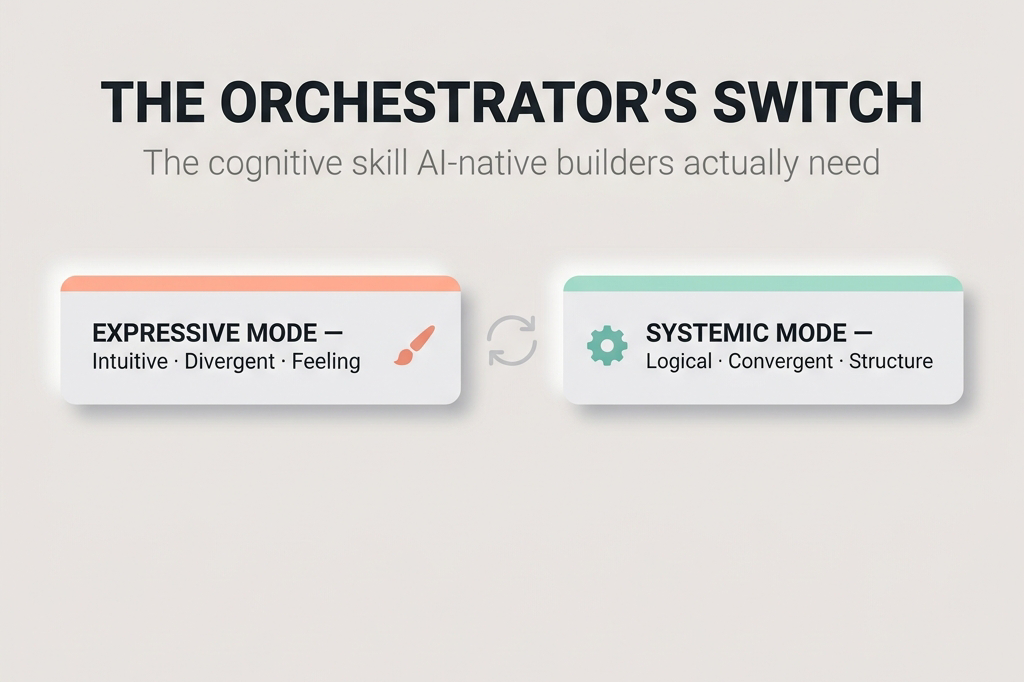
Everyone’s talking about “taste” as the core skill of the AI era. They’re not wrong, but they’re not precise enough.
“Taste” sounds vaguely artistic, and because the word is so tied to visual sensibility, it sends people down the wrong path: developing a sharper aesthetic eye, a more refined sense of beauty. That’s not it. The real skill is cognitive mode-switching: the ability to recognize which type of thinking a moment demands, and to shift into it deliberately.
AI has removed the cost barrier between thinking and building. An idea can become a working interface in minutes. That sounds like pure acceleration. It isn’t. It’s cognitive exposure. Because AI amplifies whichever mode a builder is operating in. Think loosely, and it produces beautiful chaos. Think rigidly, and it produces sterile systems. The real skill in AI-native building isn’t having both modes. It’s knowing when to use each one.
The Two Modes
Whether the role is designer, engineer, or solo builder, everyone operates in two cognitive states: Expressive Mode and Systemic Mode. These aren’t job titles. They’re ways of thinking. Everyone has both. Most people developed one more than the other.
Expressive Mode is intuitive, divergent, driven by emotion and sensory appeal. It’s concerned with feel over precision: tone, visual harmony, composition, identity, the overall character of something. The questions it asks are things like “does this feel right?” and “is it alive or is it flat?” It’s comfortable with ambiguity. It reasons inductively, spotting patterns and asking why. This is the mode that sparks a direction.
Systemic Mode is logical, convergent, structure-oriented. It prioritizes reusability, robustness, and consistency. It asks what breaks if something changes, whether a solution holds across all cases, and whether it scales without becoming incoherent. It reasons deductively. This is the mode that makes a direction durable.
A useful analogy: Expressive Mode is like writing a Chinese address, starting with the grand container (province, city, district) and drilling down to the specific recipient. Systemic Mode is like writing an English address, starting with the smallest unit (street number, street name) and building outward to the country. Both navigate the same hierarchy, but the cognitive direction is completely different. Mix up which direction the moment calls for, and the result is disorientation.
These modes aren’t opposites to conquer. They’re complementary layers, and the rhythm between them isn’t new. The Double Diamond model captured it decades ago: diverge, then converge. AI compresses that rhythm into rapid loops, which is partly what makes mode confusion so easy to fall into.
What Goes Wrong When the Modes Blur
Most AI-era building fails in one of two directions, and both have the same root cause.
The first is AI slop. Products that look polished screen-by-screen but fall apart as a whole: inconsistent spacing, conflicting visual languages, states that were never accounted for. This is what happens when a builder stays in expressive mode too long. Individual screens get over-polished. Constraints get delayed. State modeling gets avoided. AI amplifies this by producing endless aesthetic variations, each one locally beautiful, none of them coherent together.
The second is generic soup. Products that are technically sound but emotionally flat. They look like every other dashboard because they were built from the same component kit with the same defaults. This is what happens when a builder stays in systemic mode too long: over-constraining early, skipping aesthetic exploration, underestimating how much emotional resonance affects whether people actually adopt the product. AI amplifies this too, producing structurally stable but deeply boring output.
The root cause is the same in both cases: the builder was in the wrong mode for what the work required.
This isn’t always mode confusion. Sometimes one mode is simply underdeveloped. A designer who spent a decade in visual work may have extraordinary expressive instincts but has never had to think about state management. An engineer who spent years building backends may write beautiful logic but freeze when asked to make something feel a certain way. This isn’t a flaw. It’s the natural result of specialization. The capacity for both is always there. The development is what’s uneven.
AI as the Bridge (and the Mirror)
Researchers studying design and engineering students during idea generation tasks using EEG and eye-tracking found that when asked to generate original ideas, design students showed significantly stronger right-hemisphere alpha activity — a neural signature associated with internal focus and visual-mental association. Engineering students didn’t show these pronounced shifts between convergent and divergent tasks.
The insight isn’t that designers are “more creative.” It’s that design education exercised one cognitive muscle until it became dominant. Engineering education did the same for the other. Both groups had both capacities. Training made one automatic and the other effortful.
In the pre-AI era, the weaker mode was effectively a wall. A designer who couldn’t think in systems needed an engineer. An engineer who couldn’t think in aesthetics needed a designer. Crossing that wall cost another person, a handoff, and often a week.
Now AI functions as a bridge for the weaker mode. A designer can describe the feeling a product should have (expressive strength) and ask AI to generate component structure and state logic (systemic support). An engineer can define the architecture needed (systemic strength) and ask AI to explore visual directions that bring it to life (expressive support). This isn’t faking competence in the weaker mode. It’s collaborating with AI in it.
And here’s the part that compounds over time: the collaboration is itself training. Every time a designer reviews AI-generated state logic and learns to spot what’s missing, their systemic thinking gets sharper. Every time an engineer evaluates AI-generated visual options and learns to articulate why one feels better, their expressive judgment develops. The practice of switching modes with AI assistance builds the muscle that wasn’t there before.
The catch is that AI can’t decide which mode a moment calls for. That’s the orchestrator’s job.
The Switching Framework
The P0–P6 phases described in the accompanying workflow article each have a primary cognitive mode. Understanding that mapping is what separates intentional building from lucky building.
The pattern is simple: phases that open possibilities call for Expressive Mode. Phases that close possibilities into durable form call for Systemic Mode. Two phases, P4 and P6, require controlled alternation between both.
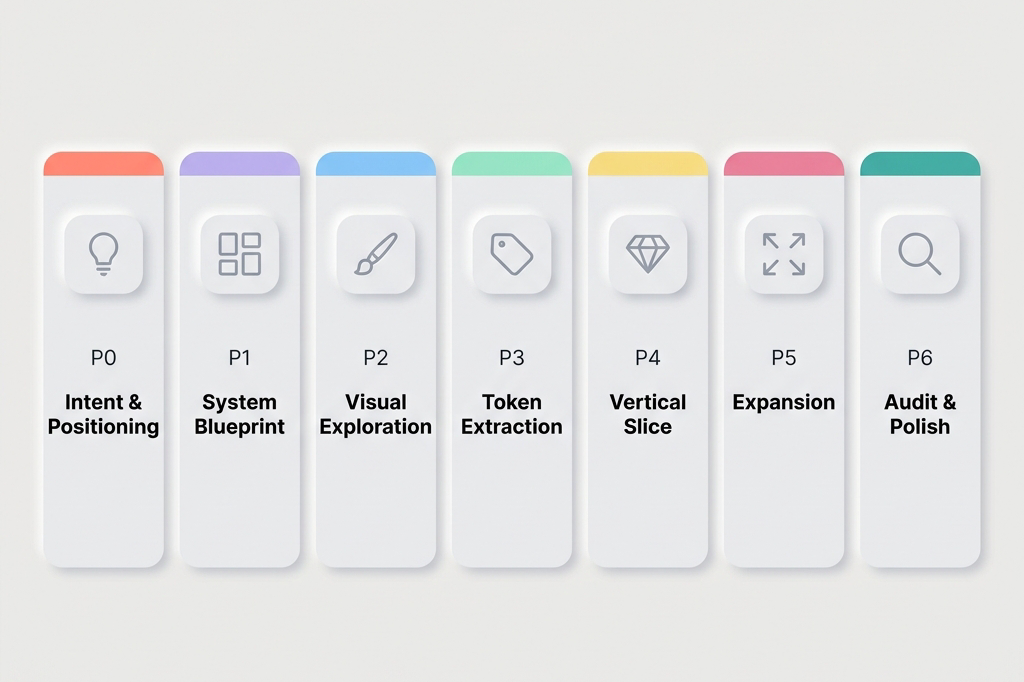
| Phase | Primary Mode | Why |
|---|---|---|
| P0: Intent & Positioning | Expressive | Vision needs to breathe before structure constrains it |
| P1: System Blueprint | Systemic | Architecture built before aesthetics, or expression has no reliable canvas |
| P2: Visual Exploration | Expressive | Exploration is now purposeful, not decoration without direction |
| P3: Token Extraction | Systemic | Vibe gets converted into rules that actually travel |
| P4: Vertical Slice | Hybrid (alternating) | Real content reveals blind spots; fixes must be validated and locked |
| P5: Expansion | Strict Systemic | Scale requires no new visual philosophy entering |
| P6: Audit & Polish | Hybrid (alternating) | Refinement is surgical; every expressive fix ends with a systemic lock-in |
The two hybrid phases deserve attention. “Hybrid” here doesn’t mean thinking in both modes simultaneously. That’s the fastest way to erode constraints quietly. It means rapid, explicit alternation: notice an issue in expressive mode, fully switch to systemic to evaluate and resolve it, update the spec or token, then switch back. The switch is the unit of work, not the blend.
Practical signals for when to switch:
Expressive → Systemic:
- Excitement is building around one direction. Excitement is the signal to stop exploring and start structuring.
- The same screen has been tweaked more than twice. That’s procrastination wearing the mask of exploration.
- The work is about to scale, or be handed to an AI agent.
Systemic → Expressive:
- Everything is technically correct but the product has no personality.
- The default component library hasn’t been questioned once.
- The product is indistinguishable from the nearest competitor.
One practical note on prompting: AI prompt style should match the active mode. In expressive phases, prompts are loose, comparative, and multimodal (images, loose text, emotional language). In systemic phases, prompts are precise, constraint-heavy, and text-only (specs, rules, defined tokens). Misalignment is one of the fastest ways to get chaos or flatness where neither was wanted.
Switching as Training
Everyone already has both expressive and systemic thinking. Most people developed one more than the other. The AI era doesn’t demand that changes overnight. It demands awareness: knowing which mode is active, and knowing which one is being avoided.
The builder who stays in expressive mode gets beautiful chaos. The builder who stays in systemic mode gets competent flatness. The builder who can switch deliberately gets something rarer: products with both soul and structure.
What makes this era different is that the practice loop is now fast. A weaker mode can be exercised without weeks of implementation cost. Consequences appear immediately. Each cycle through the phases, each deliberate switch, strengthens both muscles.
The switch isn’t just a performance tool. It’s a development engine.
每个人都在说”品味”是 AI 时代的核心技能。这没错,但不够精准。
“品味”听起来带着模糊的艺术气息,而且因为这个词与视觉感知联系太紧密,很容易把人引向错误的方向:磨砺更敏锐的审美眼光,培养更精致的美感。但这并不是核心所在。真正的技能是认知模式切换:识别某个时刻需要哪种思维方式,并有意识地切入其中的能力。
AI 已经消除了思考与构建之间的成本壁垒。一个想法可以在几分钟内变成可运行的界面。这听起来像是纯粹的加速。但其实不是——它是认知的暴露。因为 AI 会放大构建者正在运用的任何模式。思维太松散,它就产出美丽的混乱。思维太僵化,它就产出毫无生气的系统。AI 原生构建的真正技能,不是同时具备两种模式,而是知道何时使用哪一种。
两种模式
无论是设计师、工程师还是独立构建者,每个人都在两种认知状态中运作:表达模式(Expressive Mode)与系统模式(Systemic Mode)。这两者不是职位头衔,而是思维方式。每个人都有这两种能力,只是大多数人把其中一种发展得更深。
表达模式是直觉的、发散的,由情感和感官驱动。它关注感受而非精确性:语气、视觉和谐、构图、身份认同,以及某件事物整体的性格特征。它问的问题是”这样感觉对吗?“和”它有生命力还是一片死寂?“它能与模糊共存。它以归纳方式推理,捕捉规律并追问”为什么”。这是点燃方向的模式。
系统模式是逻辑的、收敛的、以结构为导向的。它优先考虑可复用性、健壮性和一致性。它会问:如果某个东西改变了,什么会随之崩溃?这个解决方案在所有情况下都成立吗?它能在不变得混乱的情况下扩展吗?它以演绎方式推理。这是让方向得以持久的模式。
一个有用的类比:表达模式像中文地址的书写方式,从最大的容器(省、市、区)一路钻到具体的收件人。系统模式像英文地址,从最小的单元(门牌号、街道名)开始,向外延伸到国家。两者都在导航同一套层级,但认知的方向截然不同。搞错了某个时刻该走哪个方向,结果就是迷失。
这两种模式不是需要征服的对立面,而是互补的层次。它们之间的节奏并不是什么新鲜事——“双钻”模型在几十年前就捕捉到了这一点:先发散,再收敛。AI 将这个节奏压缩成了快速循环,这也是模式混淆如此容易发生的原因之一。
模式模糊时会出什么问题
AI 时代的大多数构建失败都以两种方式之一呈现,而两者有着相同的根本原因。
第一种是 AI 烂货(AI slop)。产品屏幕单独来看很精致,但整体却支离破碎:间距不一致、视觉语言相互冲突、很多状态从未被考虑过。这就是构建者在表达模式中停留太久的结果。单个屏幕被过度打磨。约束被一再推迟。状态建模被刻意回避。AI 通过产生无休止的美学变体来放大这一点——每一个局部来看都很美,但放在一起却毫无连贯性。
第二种是通用汤(generic soup)。产品在技术上无懈可击,但情感上一片苍白。它们看起来和每一个其他仪表盘一模一样,因为它们都用相同的组件库和相同的默认值搭建而成。这就是构建者在系统模式中停留太久的结果:过早约束、跳过美学探索、低估情感共鸣对产品是否真正被采用的影响。AI 同样会放大这一点,产出在结构上稳固但让人昏昏欲睡的东西。
两种情况的根本原因是一样的:构建者在那个时刻处于错误的模式中。
这并不总是模式混淆的问题,有时只是某种模式发展不足。在视觉工作中浸泡了十年的设计师,可能拥有非凡的表达直觉,却从未考虑过状态管理。花了多年时间构建后端的工程师,可能写出漂亮的逻辑,但当被要求让某个东西”产生某种感觉”时却一片茫然。这不是缺陷,而是专业化的自然结果。两种能力始终都在——不均衡的只是发展程度。
AI 作为桥梁(也作为镜子)
研究人员通过 EEG 和眼动追踪研究了设计专业和工程专业学生在创意生成任务中的大脑活动。当被要求产生原创想法时,设计系学生表现出明显更强的右半球 alpha 活动——这是一种与内部专注和视觉联想相关的神经信号。工程系学生在收敛与发散任务之间没有表现出这种明显的切换。
这里的洞见不是”设计师更有创造力”,而是设计教育锻炼了某块认知肌肉,直到它变得占主导位置。工程教育对另一块肌肉做了同样的事。两组人都拥有两种能力,只是训练让一种变得自动化,让另一种变得费力。
在前 AI 时代,较弱的模式实际上就是一堵墙。无法进行系统思考的设计师需要一位工程师。无法进行审美思考的工程师需要一位设计师。跨越那堵墙意味着另一个人、一次交接,通常还有一周的时间代价。
现在,AI 为较弱的模式充当了桥梁。设计师可以描述产品应有的感觉(表达优势),然后请 AI 生成组件结构和状态逻辑(系统支持)。工程师可以定义所需的架构(系统优势),然后请 AI 探索能让其焕发生命力的视觉方向(表达支持)。这不是在较弱的模式中假装能力,而是在其中与 AI 协作。
而随时间复利的是:这种协作本身就是训练。每一次设计师审查 AI 生成的状态逻辑并学会发现其中缺失的东西,他们的系统思维就会更敏锐一分。每一次工程师评估 AI 生成的视觉选项并学会表达为什么某一个感觉更好,他们的表达判断就会更进一步。借助 AI 辅助来切换模式的实践,正在锻炼那块原本不存在的肌肉。
问题在于,AI 无法决定某个时刻需要哪种模式。那是指挥者的工作。
切换框架
配套工作流文章中描述的 P0 至 P6 各阶段,每个都有其主要的认知模式。理解这种映射关系,正是有意识构建与碰运气构建之间的区别。
规律很简单:开放可能性的阶段需要表达模式;将可能性收敛为持久形式的阶段需要系统模式。P4 和 P6 两个阶段需要两者之间的受控交替。
| 阶段 | 主要模式 | 原因 |
|---|---|---|
| P0:意图与定位 | 表达模式 | 结构约束之前,愿景需要先自由呼吸 |
| P1:系统蓝图 | 系统模式 | 架构先于美学,否则表达就没有可靠的画布 |
| P2:视觉探索 | 表达模式 | 探索现在是有目的的,而非无方向的装饰 |
| P3:Token 提取 | 系统模式 | 将 Vibe 转化为真正可传递的规则 |
| P4:垂直切片 | 混合(交替) | 真实内容揭示盲点;修复必须经过验证并锁定 |
| P5:扩张 | 严格系统模式 | 规模化要求不引入任何新的视觉哲学 |
| P6:审计与打磨 | 混合(交替) | 精调是外科手术式的;每一次表达修复都以系统锁定结束 |
两个混合阶段值得特别关注。这里的”混合”不是指同时在两种模式中思考——那是悄悄侵蚀约束最快的方式。它的意思是快速的、明确的交替:在表达模式中发现一个问题,完全切换到系统模式来评估和解决它,更新规范或 token,然后再切换回来。切换是工作的单元,而不是混合。
何时切换的实用信号:
表达 → 系统:
- 对某个方向的兴奋感正在积累。兴奋是停止探索、开始结构化的信号。
- 同一个屏幕已经被调整超过两次。那是拖延穿着探索的外衣。
- 工作即将扩展规模或移交给 AI 智能体。
系统 → 表达:
- 一切技术上都正确,但产品毫无个性。
- 默认组件库从未被质疑过一次。
- 产品与最近的竞品无法区分。
关于提示词的一个实践性说明:AI 提示词的风格应与当前模式相匹配。在表达阶段,提示词宽松、比较性强,并且多模态(图片、宽泛文字、情感语言)。在系统阶段,提示词精确、约束繁多,且纯文字(规范、规则、定义好的 token)。错位是以最快速度制造混乱或平庸的方式之一。
切换即训练
每个人都已经具备表达和系统两种思维方式。大多数人只是将其中一种发展得更深。AI 时代并不要求这一情况在一夜之间改变,它要求的是觉察:知道哪种模式正在被使用,以及哪种模式正在被回避。
一直停留在表达模式中的构建者,会得到美丽的混乱。一直停留在系统模式中的构建者,会得到称职的平庸。能够有意识切换的构建者,会得到更罕见的东西:兼具灵魂与结构的产品。
这个时代的不同之处在于,练习的循环现在变得很快。较弱的模式可以在不付出数周实现成本的情况下得到锻炼。后果会立即显现。每一次穿越这些阶段的循环,每一次有意识的切换,都在同时强化两块肌肉。
切换不只是一种性能工具,它是一台发展引擎。